
Implantologist reveals little-known science behind why orthodontic patients develop permanent enamel damage despite "perfect" brushing routines — and the 10-second solution that actually works
If you have braces, you probably know the feeling.
That trapped food you can feel but can't reach. Those white chalky spots starting to appear around your brackets. That 20-minute bathroom ordeal after every meal with floss threaders, interdental brushes, and water flossers. And even then, you KNOW food is still stuck somewhere.
For months, you've heard your orthodontist and hygienist tell you to "brush better" and "be more thorough." And honestly, you probably believed them. Most orthodontic patients do.
They think: "If I just spend more time. If I just use every tool they recommend. If I just never miss a brushing session after meals..."
But here's what they don't tell you: brushing harder doesn't solve a physics problem.
I'm Dr. Toni Martinčević, an implantologist specializing in advanced dental reconstruction. Over the past decade, I've treated hundreds of patients who came to me AFTER their orthodontic treatment was complete — devastated by the permanent white spot lesions, decalcification marks, and enamel damage that appeared the day their braces came off.
These weren't neglectful patients. They were the ones who followed every instruction. Brushed after every meal. Carried elaborate oral care kits to school and work. Spent 30 minutes twice daily on their routine.
And they STILL ended up with permanent damage that required expensive cosmetic procedures to fix.
That's when I started researching the actual mechanism behind orthodontic white spot formation. What I discovered changed everything — and led me to develop CariSpray specifically for orthodontic patients.
Here are the 7 things I wish every braces patient understood from day one:
Here's the uncomfortable truth your orthodontist probably hasn't emphasized enough:
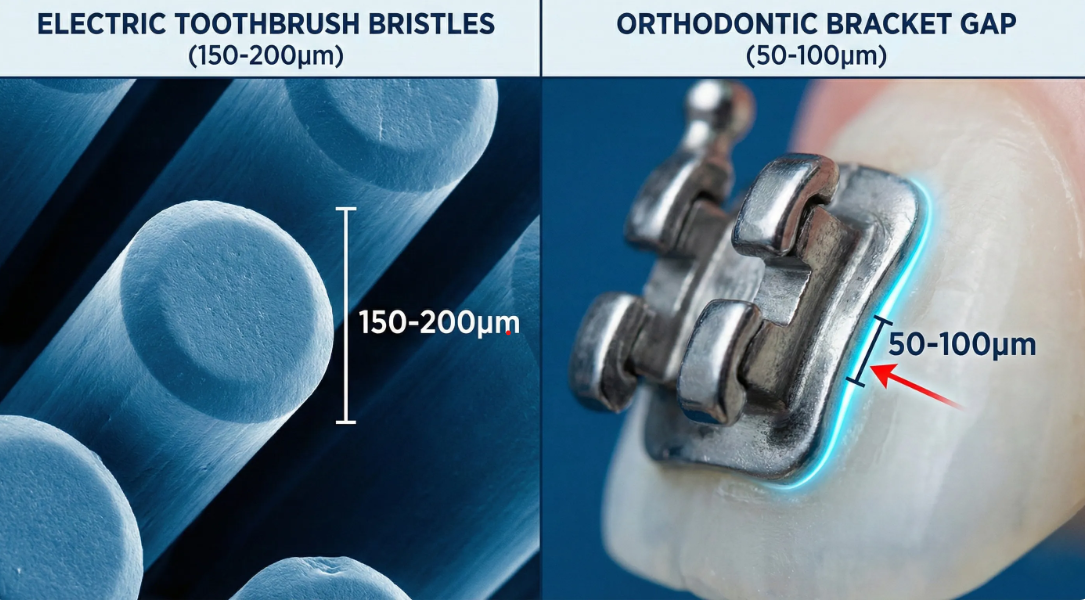
Brackets, bands, and wires create countless microsurfaces that are physically impossible to reach with a toothbrush.
Think about it. When brushing, your toothbrush bristles can only clean surfaces they can physically touch. But orthodontic brackets are bonded directly to your tooth enamel, creating a sealed edge where the bracket meets the tooth. Food particles and bacteria don't just sit ON your teeth — they get trapped in the microscopic space between the bracket and your enamel.
Your toothbrush? It can't reach under that bracket edge. Your floss threader? Can't get under there either. Your water flosser? It might blast away visible food debris, but it's not addressing the bacterial acid production happening in those sealed-off spaces.
This isn't a hygiene problem. It's a physics problem.
You could brush for an hour with the most expensive toothbrush in the world, and you still wouldn't be able to physically reach the tooth surfaces where white spots form.
Most orthodontic patients think white spots are something that develops slowly over time — maybe in the final months of treatment if they "slack off" on oral care.
That's not how it works.
Here's what's actually happening in your mouth right now:
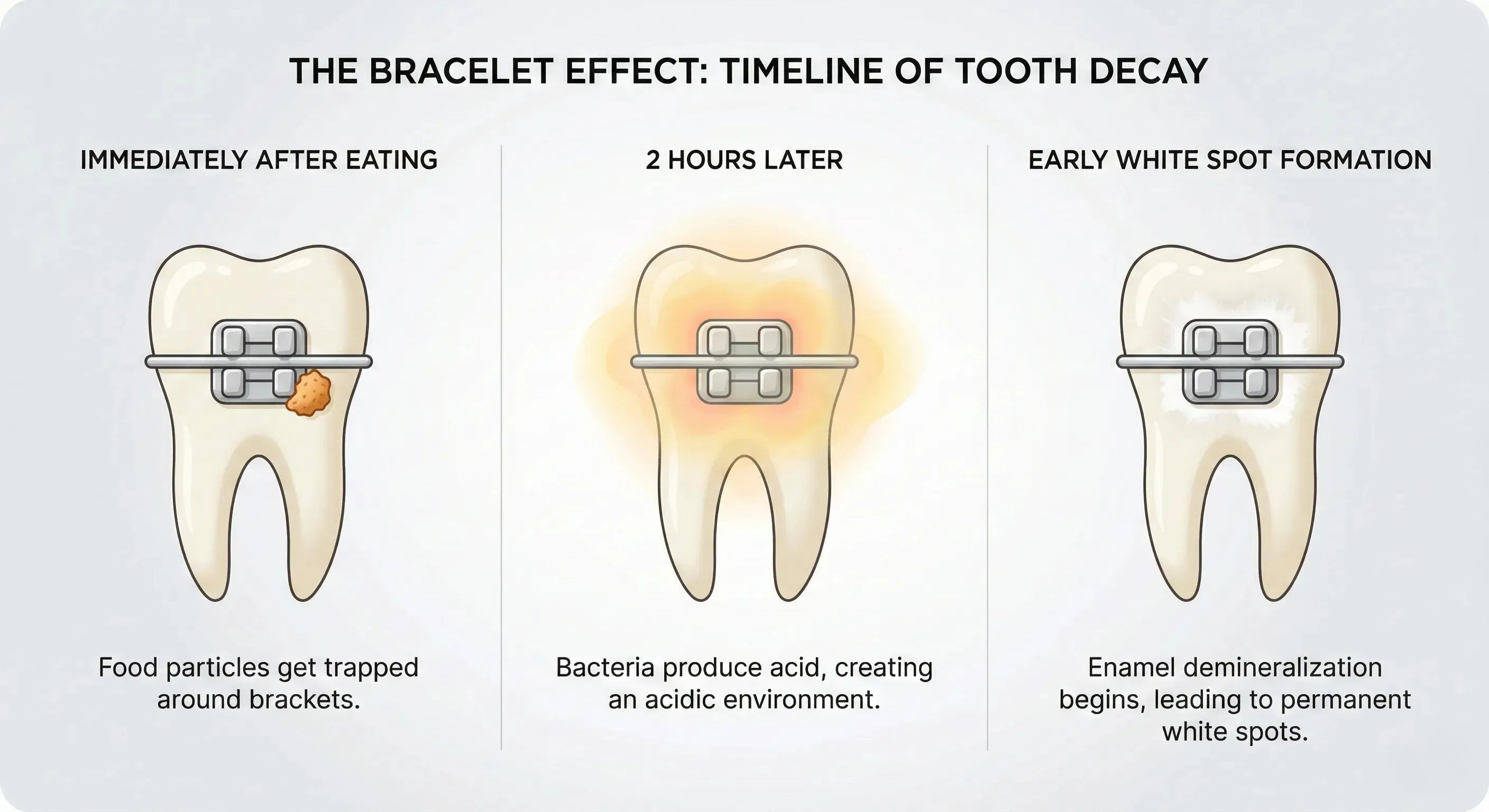
When you eat, bacteria in your mouth metabolize sugars and carbohydrates, producing acid. Within minutes, your mouth's pH drops from a healthy 7.0 down to 5.5 or lower — the "critical pH" where enamel demineralization begins.
In a normal mouth without braces, saliva naturally neutralizes this acid within 30–60 minutes. But with braces, food particles trapped under brackets and between wires continue feeding bacteria for HOURS, creating a continuous acid bath against your enamel.
This acid leaches calcium and phosphate from your enamel's mineral structure. As the enamel loses minerals, it becomes more porous and begins to scatter light differently — that's what creates the chalky white appearance.
The key phrase there? "When the treatment could actually reach the surfaces."
Traditional toothpaste and mouthwash can't penetrate through brackets and wires to deliver remineralizing ingredients where they're needed most.
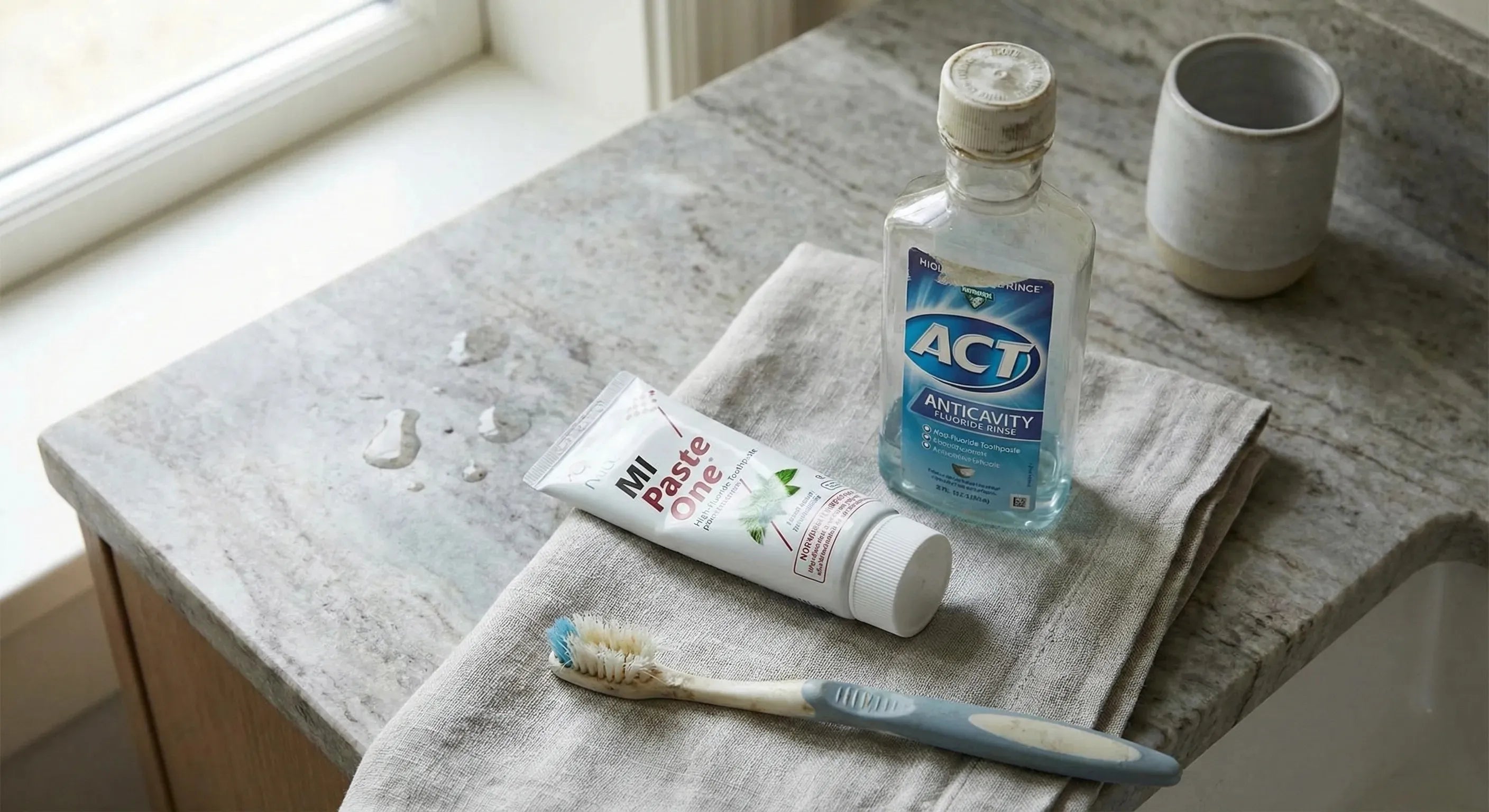
If your orthodontist is on top of things, they probably prescribed you a high-fluoride toothpaste or mouth rinse. Maybe MI Paste or something similar.
These products DO help strengthen enamel when they can make contact with it.
But here's the problem: they face the exact same physical barrier your toothbrush does.
High-fluoride toothpaste applied with a toothbrush can only reach the surfaces the bristles touch. The areas around your bracket edges? Not getting adequate fluoride exposure.
Fluoride mouth rinse? It swishes around the OUTSIDE of your teeth and around the front of your brackets. But the sealed edges where brackets meet enamel? The acid is trapped in there, and the fluoride rinse can't penetrate deep enough to neutralize it.
Plus, here's something most patients don't realize: fluoride's effectiveness is pH-dependent.
According to research on orthodontic remineralization, fluoride works best in a neutral to slightly alkaline environment. But the space under your brackets where food is trapped? That's a highly acidic environment (pH 5.5 or lower). At that pH, fluoride's remineralization potential is significantly compromised.
That's why I've seen countless patients who faithfully used prescription fluoride products throughout their entire orthodontic treatment... and still ended up with white spots.
The fluoride wasn't the problem. The delivery method was.
Most orthodontic oral care advice focuses on mechanical removal: brush away the food, floss away the plaque, blast it out with water flossers.
But white spot formation isn't primarily a mechanical problem — it's a chemical problem.
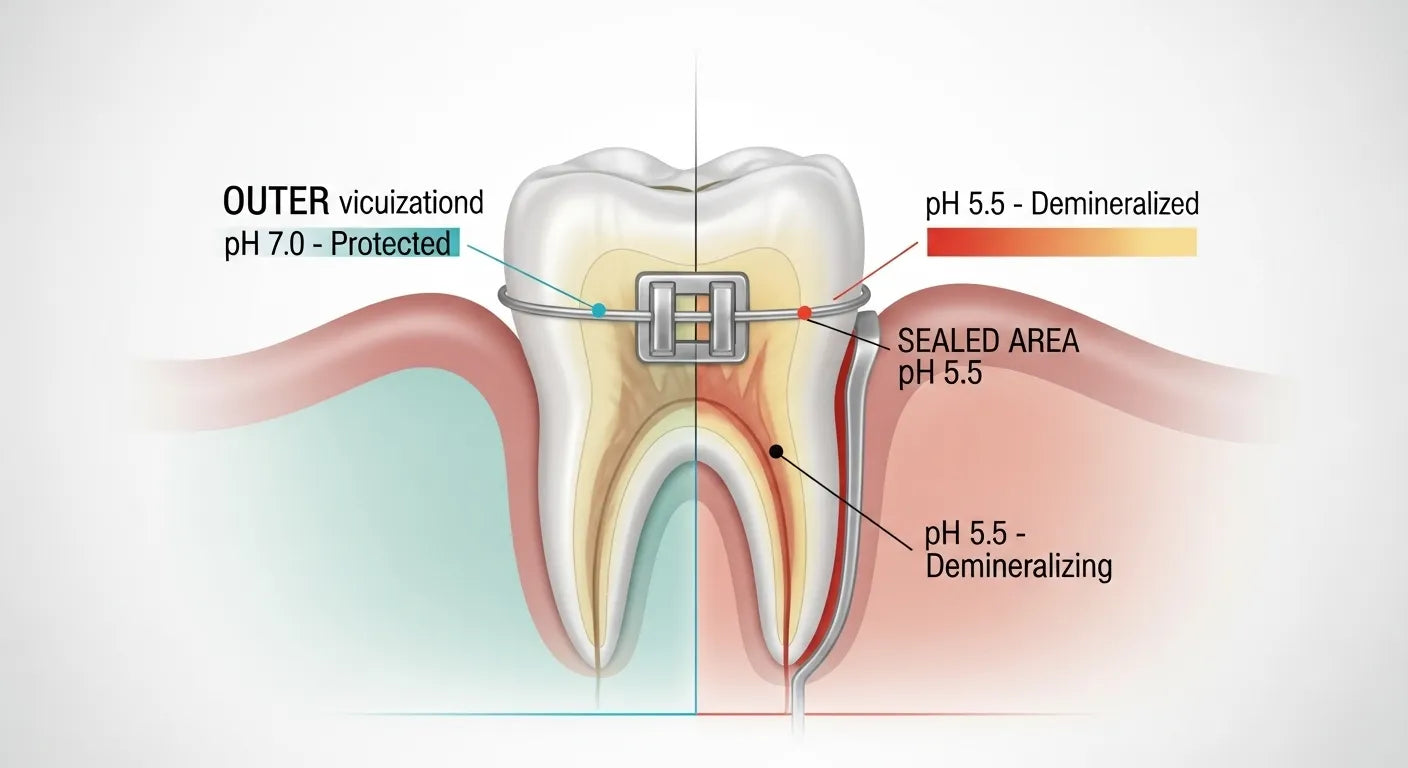
Here's what research shows: When your mouth's pH drops below 5.5 (the "critical pH"), your enamel begins to demineralize. That means the calcium and phosphate that make up your tooth structure start dissolving into your saliva.
For people without braces, saliva naturally buffers this acid within 30–60 minutes, bringing pH back up to protective levels.
For people WITH braces, food trapped around brackets creates localized acid zones that can persist for 4–6 hours or longer. Your saliva can't reach these areas to neutralize them.
So you end up with this situation:
You could be brushing perfectly, and this chemical attack would still be happening in the spaces you physically cannot reach.
This is why timing matters more than effort. It's not about brushing for 30 minutes. It's about rapidly neutralizing acid in hard-to-reach areas immediately after eating.
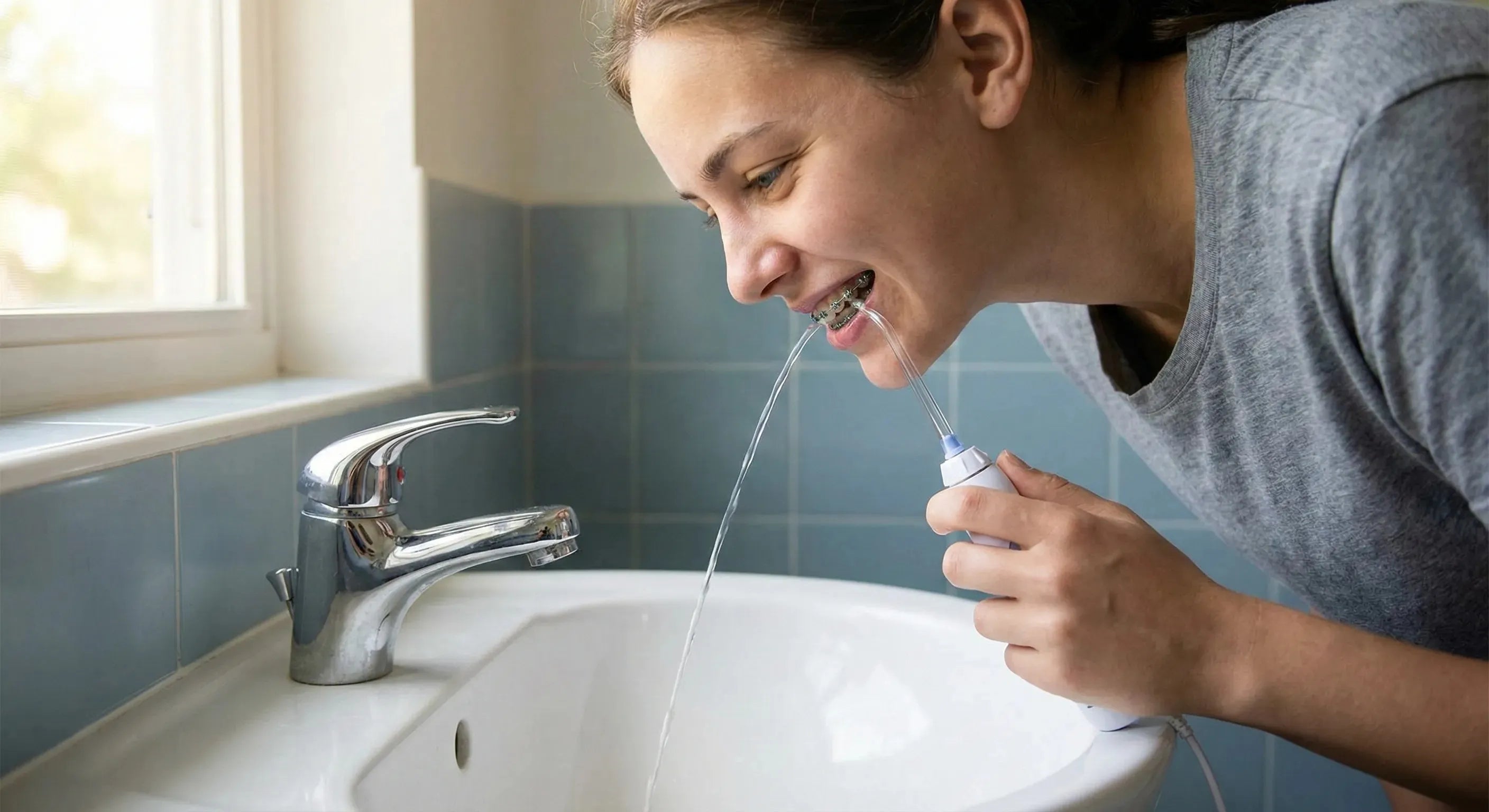
Water flossers (Waterpik, etc.) have become incredibly popular with orthodontic patients. And for good reason — they do an excellent job of blasting visible food debris out from between brackets and around wires.
But here's what they don't do: prevent the chemical demineralization process that creates white spots.
Water flossers are mechanical devices. They remove particles through water pressure. That's helpful for oral hygiene and preventing gum inflammation.
But removing visible food doesn't address:
I've had patients tell me: "I use my Waterpik religiously after every meal. Why am I still getting white spots?"
Because the Waterpik removed the big pieces of food your hygienist can see. But the demineralization process is happening at a microscopic, chemical level in spaces that water pressure can't adequately reach or neutralize.
You need something that can:
This is where everything I learned as an implantologist came together.
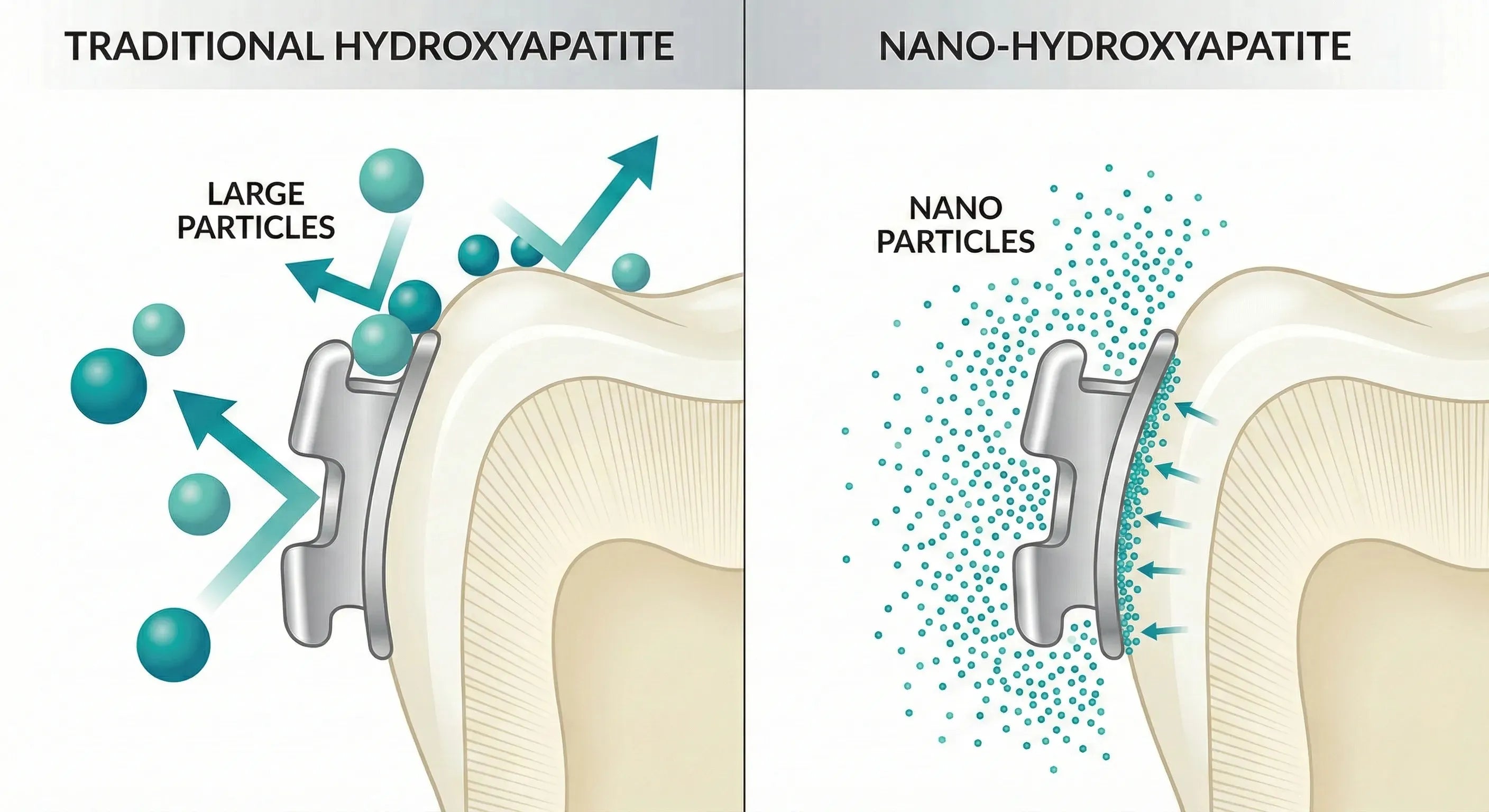
Hydroxyapatite is not new — it's been used in dentistry for decades. It's literally the same mineral that makes up 97% of your tooth enamel. When you apply it topically, it biomimetically bonds to your enamel and helps rebuild the mineral structure.
But traditional hydroxyapatite particles are too large to penetrate into the microscopic spaces where orthodontic white spots form.
Nano-hydroxyapatite changes this completely. The particles are 20–80 nanometers — small enough to penetrate into enamel tubules, around bracket edges, and into the microscopic spaces traditional products can't reach.
But here's what made me develop CariSpray specifically as a SPRAY delivery system:
Spray penetration reaches where brushing physically cannot.
When you spray CariSpray into your mouth after eating, the fine mist:
A spray takes 10 seconds to use. You don't need a bathroom, special tools, or 20 minutes of your day.
And unlike traditional toothpaste or mouthwash, the spray's penetration ability means you're actually treating the surfaces where white spots form — not just the visible exterior of your teeth.
Here's the final piece most orthodontic patients don't understand:
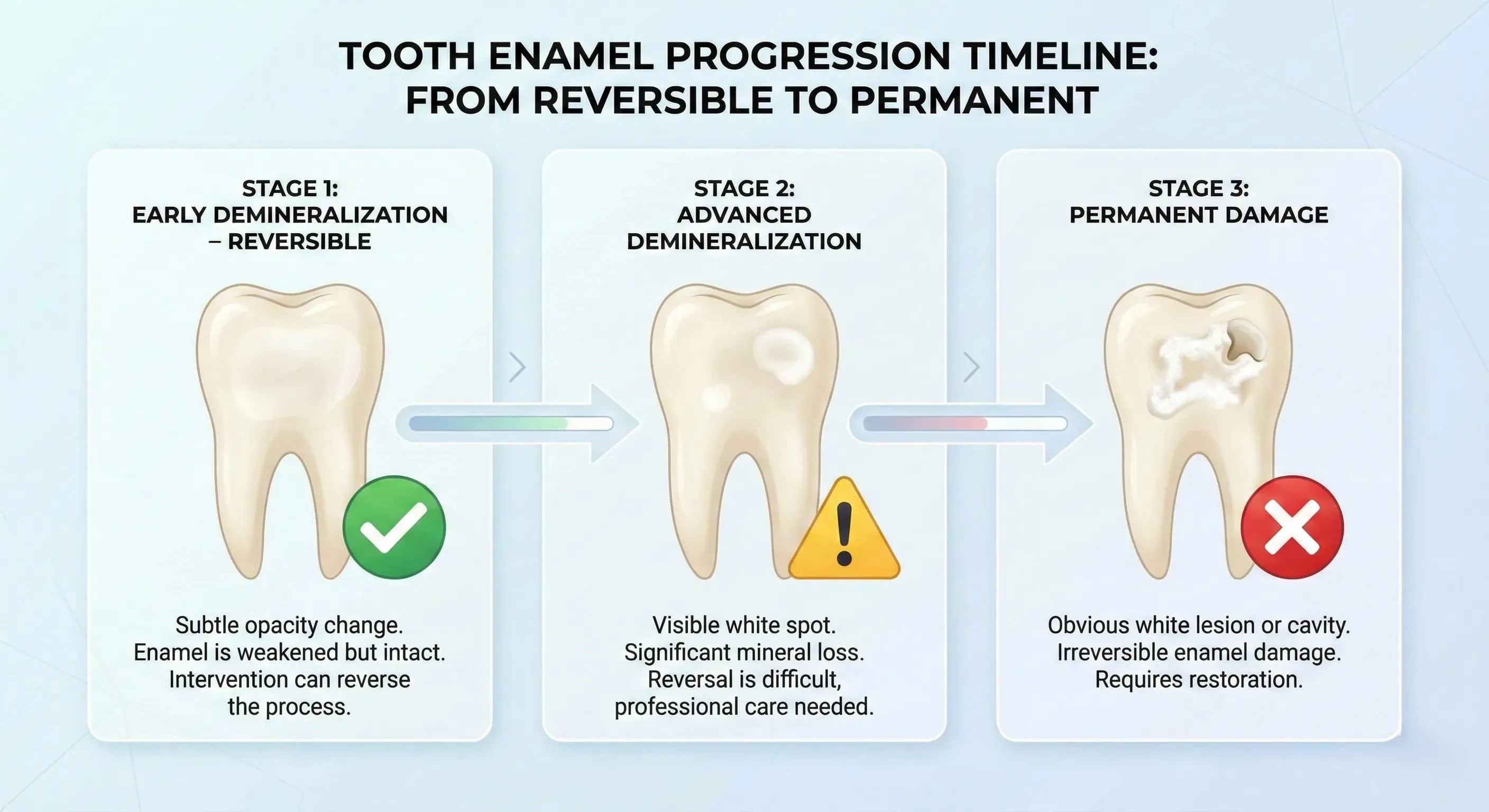
Once enamel demineralization progresses past a certain point, it becomes permanent.
In the early stages, white spot lesions can be reversed through remineralization. The demineralized enamel is still structurally intact — it's just lost minerals. If you can deliver calcium and phosphate back into that structure and maintain a neutral pH, the enamel can rebuild itself.
But if demineralization continues unchecked for weeks or months, the enamel structure breaks down completely. At that point, no amount of remineralization therapy can fully restore it. You're left with permanent white marks that require professional cosmetic treatment to address.
The 2020 BioMed Research International study I mentioned earlier found something fascinating: nano-hydroxyapatite showed "great visual remineralization effect after just the second application cycle" in orthodontic patients.
But only when applied to enamel that was in the early stages of demineralization.
This is why waiting until you SEE white spots is often too late. By the time the white chalky appearance is visible to you, significant demineralization has already occurred.
Prevention is exponentially more effective than reversal.
Using a remineralizing spray immediately after eating — before acid damage accumulates — keeps you in the "reversible" stage. Your enamel can repair itself with each application.
Waiting until your orthodontist points out white spots at your next adjustment appointment? Now you're playing catch-up, trying to reverse months of accumulated damage.
Look, I'm not saying you should stop brushing or throw away your floss threaders.
Traditional oral hygiene is still important for gum health and removing visible debris.
But if you're one of the thousands of orthodontic patients spending 20–30 minutes daily on oral care and STILL worried about white spots...
It's time to address the actual mechanism behind the problem.
You need something that:
That's exactly why I developed CariSpray.
It's not a replacement for brushing. It's the missing piece that addresses the physics and chemistry problems brushing cannot solve.
CariSpray combines three mechanisms in a single spray:
Sodium bicarbonate and potassium compounds immediately raise mouth pH from acidic (5.5) to protective alkaline (7.0+) — stopping acid damage within 30 seconds of spraying.
Pharmaceutical-grade 20nm particles (the same size used in the successful orthodontic studies) penetrate into enamel structure to actively rebuild mineral content.
25% xylitol concentration disrupts cavity-causing bacteria's metabolism, reducing acid production at the source.
The spray delivery system is crucial: it reaches surfaces where traditional products cannot penetrate.
The nano-hydroxyapatite technology in CariSpray isn't experimental — it's backed by peer-reviewed research specifically in orthodontic populations:
This isn't theory. It's documented, peer-reviewed science.
Using CariSpray is simpler than any other orthodontic oral care product:

Every day you're in braces without adequate remineralization support is another day of potential enamel damage.
Remember: once demineralization progresses past early stages, it becomes permanent.
The white spots you see when your braces come off? Those are the result of accumulated daily acid damage that went unchecked throughout treatment.
You're investing $5,000–8,000 and 18–36 months of your life into a perfect smile. Doesn't it make sense to invest in protecting your enamel during the process?

I'm so confident CariSpray will protect your enamel during orthodontic treatment that I'm offering a 60-day money-back guarantee. Use it throughout your treatment period. If you're not completely satisfied that CariSpray is making a measurable difference in your orthodontic oral care, return it for a full refund. No questions asked.
CHECK AVAILABILITY →You've already committed to the time, expense, and daily inconvenience of orthodontic treatment.
You're already spending 20+ minutes daily on oral care routines that still don't reach where white spots form.
CariSpray isn't asking you to do more. It's asking you to do something DIFFERENT — something that actually addresses the physics and chemistry of orthodontic demineralization.
Protect your investment. Protect your enamel. Protect the smile you're working so hard to achieve.
Protect your enamel during every stage of orthodontic treatment
Protect Your Smile Now ✨Dr. Martinčević is a practicing implantologist who developed CariSpray after treating hundreds of post-orthodontic patients with permanent enamel damage. His clinical focus on prevention led him to research nano-hydroxyapatite delivery systems specifically optimized for hard-to-reach oral surfaces. CariSpray represents the culmination of that research — pharmaceutical-grade ingredients in a convenient format designed for real-world compliance.